
2027-2028
Temporomandibular
Disorders &
Orofacial Pain
12-month advanced Continuing Education Hybrid Program
Education providers:


Educational methods
Lectures, participation, and self-instruction in a hybrid format.
Program dates
April 24 2027 to March 25 2028
Recommended participant level
Beginner to intermediate
Continuing education hours
Total 120 hours
60 hours
In-person training
30 hours
Live virtual sessions
30 hours
Self-instruction (guided)
Learning hours
Months
Virtual modules
Onsite modules
PROGRAM OVERVIEW
This university-based continuing education program is planned as a collaboration between the Orofacial Sleep Consortium and the UT Health San Antonio School of Dentistry Office of Continuing Dental Education. It combines structured online education, guided self-study, faculty mentorship and supervised onsite clinical-practical learning.
Temporomandibular disorders (TMDs) and orofacial pain conditions are common, clinically heterogeneous, and frequently encountered across general and specialty dental practice. They may involve the temporomandibular joints, masticatory muscles, cranial nerves, headache disorders, sleep and behavioral contributors, systemic disease, or pain referred from dental and nondental structures. Because symptoms can overlap and serious mimics must be recognized, dentists require more than procedural familiarity: they need structured preparation in pain mechanisms, validated assessment, differential diagnosis, conservative care, outcome monitoring, and timely interdisciplinary referral.
This program establishes foundational learning through a sequenced 120-hour curriculum combining live instruction, guided evidence appraisal, supervised clinical-practical learning, competency-based assessment, longitudinal case development, and interdisciplinary referral skills. The intended outcome is safer, more conservative, evidence-informed, and patient-centered care within each dentist’s competence, licensure, and scope of practice.
In-person venue
San Antonio, Texas. USA 🇺🇸
UT Health San Antonio School of Dentistry
8210 Floyd Curl Drive, San Antonio, TX 78229
CURRICULUM AND MODULE DESCRIPTIONS
PROGRAM BEGINS
APRIL 2027
Ten modules and two supervised, three-day onsite experiences connect foundational knowledge with clinical assessment and management of temporomandibular disorders and orofacial pain. The curriculum emphasizes evidence-informed decisions, conservative care, interdisciplinary collaboration, and the integration of sleep-related conditions into clinical practice.
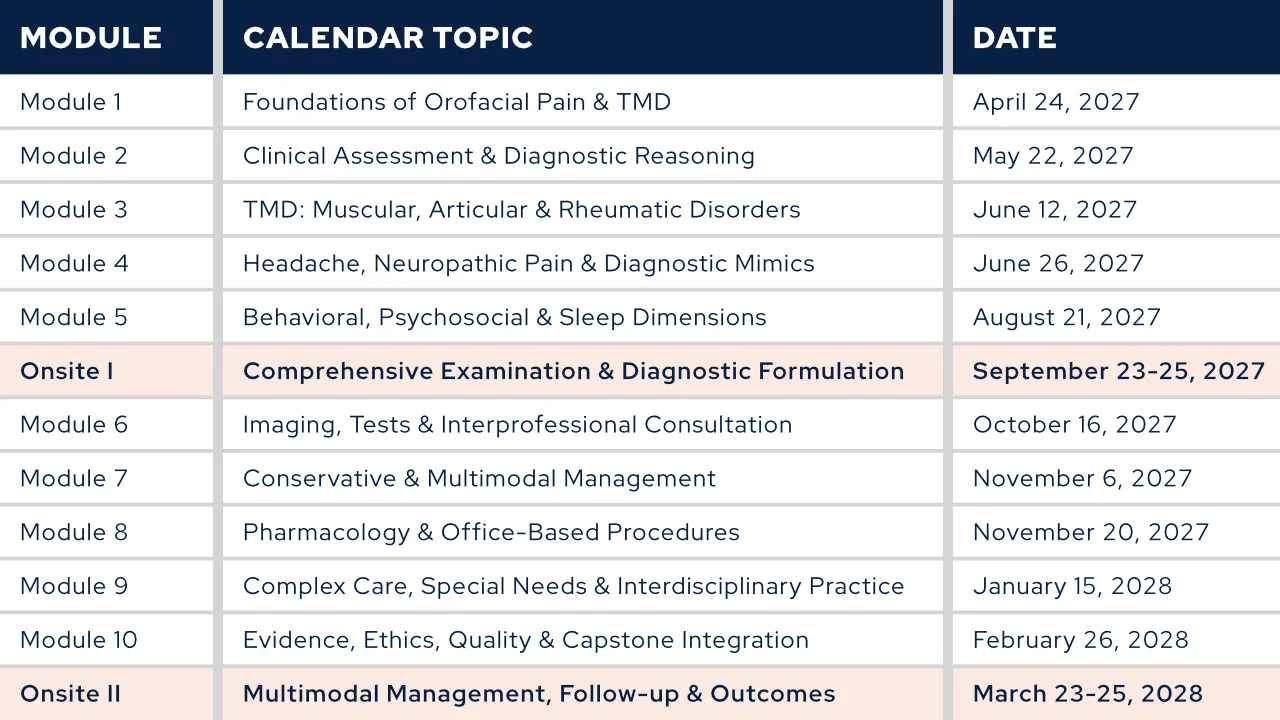
LIVE VIRTUAL MODULE
Ξ April 24, 2027
Module 1
Foundations of Orofacial Pain
and TMD
Curriculum
Overview: Describe the functional anatomy and physiology of the masticatory system, temporomandibular joint (TMJ), and craniofacial and cervical structures. Explain peripheral and central pain mechanisms, sensitization, and referred pain; review epidemiology and major classification frameworks; and distinguish supported pain mechanisms from unsubstantiated structural explanations.
Core topics
- Pain neurobiology, referred pain, peripheral and central mechanisms, and sensitization.
- Gross and functional anatomy relevant to temporomandibular disorders (TMD).
- Epidemiology and terminology; introduction to the Diagnostic Criteria for TMD (DC/TMD) and the International Classification of Orofacial Pain (ICOP).
- Odontogenic and nonodontogenic pain; clinical interpretation of occlusal and skeletal variation.
LIVE VIRTUAL MODULE
Ξ May 22, 2027
Module 2
Clinical Assessment
and Diagnostic Reasoning
Curriculum
Overview: Conduct a comprehensive pain interview integrating medical, dental, sleep, behavioral, and psychosocial information. Perform a standardized examination, identify red flags, develop a prioritized problem list and differential diagnosis, and document findings clearly to support clinical decisions and continuity of care.
Core topics
- Pain history, functional impact, and patient goals.
- Musculoskeletal, TMJ, cervical, cranial nerve, oral, head and neck, and vital sign screening.
- Range of motion, palpation, symptom provocation, and interpretation of examination findings.
- Red flags, urgent referral, diagnostic uncertainty, and Subjective, Objective, Assessment, and Plan (SOAP) documentation.
LIVE VIRTUAL MODULE
Ξ June 12, 2027
Module 3
Muscular and Articular TMD
and Rheumatic Disorders
Curriculum
Overview: Differentiate common pain-related and intra-articular TMD presentations. Recognize degenerative, inflammatory, traumatic, and systemic contributors; select initial conservative care; and determine when imaging or consultation with rheumatology or oral and maxillofacial surgery is indicated.
Core topics
- Myalgia, myofascial pain, and arthralgia.
- Disc displacement, degenerative joint disease, and subluxation.
- Evaluation of rheumatic and systemic inflammatory disease affecting the TMJ.
- Prognosis, response to initial care, and criteria for escalation or referral.
LIVE VIRTUAL MODULE
Ξ June 26, 2027
Module 4
Headache and Neuropathic Pain
in the Differential Diagnosis
Curriculum
Overview: Differentiate primary headache disorders, warning features of secondary headache, cranial neuralgias, painful trigeminal neuropathies, persistent idiopathic facial pain, and conditions that mimic odontogenic pain. Recognize medication-overuse headache and coordinate urgent or routine referral according to the clinical presentation.
Core topics
- Primary and secondary headache disorders, mechanisms, and warning features.
- Trigeminal neuralgia and painful post-traumatic trigeminal neuropathy.
- Persistent idiopathic facial pain and other nonodontogenic pain presentations.
- Medication-overuse headache and indications for urgent or routine referral.
LIVE VIRTUAL MODULE
Ξ August 21, 2027
Module 5
Axis II Biobehavioral
and Psychosocial Evaluation
Curriculum
Overview: Interpret pain-related disability and psychosocial risk using validated screening tools within the dental scope of practice. Communicate without stigma, incorporate self-management and behavior-change principles, recognize sleep dysfunction, and screen for sleep-related breathing disorders when referral is appropriate.
Core topics
- Biopsychosocial formulation, pain-related disability, pain behavior, and contextual factors.
- Depression, anxiety, somatic symptom burden, and pathways for safety escalation and referral.
- Education informed by cognitive behavioral therapy (CBT), habit reversal, relaxation, stress management, and sleep strategies.
- Use and interpretation of validated screening tools; sleep-related concerns and referral coordination.
ONSITE I
Ξ September 23-25, 2027
Onsite clinical-practical module
Comprehensive Examination
and Diagnostic Assessment
Curriculum
Three-day supervised onsite practical after Modules 1–5
Overview: Perform a comprehensive orofacial pain evaluation under direct faculty observation. Synthesize medical, dental, pain, sleep, behavioral, and psychosocial information; complete a standardized examination; identify red flags; determine the need for further testing or referral; and formulate a prioritized problem list and differential diagnosis.
Core practical activities
- Structured pain history and integration of medical, dental, sleep, behavioral, and psychosocial findings.
- Calibrated head and neck, cranial nerve, cervical, masticatory muscle, and TMJ examination.
- Red flags, additional testing, referral decisions, and formulation of a differential diagnosis.
- Introductory appliance design and selection; indications, risks, and follow-up.
- Diagnostic and therapeutic injections and botulinum toxin: case-based review and supervised demonstration or practice within scope.
LIVE VIRTUAL MODULE
Ξ October 16, 2027
Module 6
Diagnostic Testing and
Interprofessional Consultation
Curriculum
Overview: Select imaging and other tests when the results are expected to influence care. Interpret common TMJ imaging findings within their limitations, recognize indications for laboratory studies, psychometric assessment, sleep testing, or specialist consultation, and communicate a focused clinical question to the receiving clinician.
Core topics
- Panoramic imaging, cone beam computed tomography (CBCT), computed tomography (CT), magnetic resonance imaging (MRI), and ultrasound: indications and limitations.
- Incidental findings and correlation of imaging with clinical findings.
- Laboratory studies, systemic disease evaluation, and indications for psychometric assessment and sleep testing.
- Consultation with radiology, neurology, rheumatology, sleep medicine, otolaryngology, behavioral health, and surgery.
LIVE VIRTUAL MODULE
Ξ November 6, 2027
Module 7
Conservative and
Multimodal Management
Curriculum
Physical Therapy and Cervical Evaluation
Overview: Develop treatment goals linked to the diagnosis and obtain informed consent. Integrate education, self-management, physical therapy, cervical assessment, intraoral appliances, and behavioral strategies. Use shared decision-making, monitor outcomes, coordinate rehabilitation, and revise or discontinue ineffective interventions.
Core topics
- Patient education, reassurance, activity pacing, and self-management.
- Physical therapy, cervical evaluation, home exercise, and rehabilitation referral.
- Selection and monitoring of intraoral appliances and behavioral strategies; sequencing of multimodal care and measurement of outcomes.
LIVE VIRTUAL MODULE
Ξ November 20, 2027
Module 8
Pharmacologic Management
of Orofacial Pain
Curriculum
Select medications according to the pain mechanism, patient history, and treatment goals. Screen for contraindications and interactions, prescribe and monitor safely, and recognize medication overuse, dependence, and withdrawal risks. Review the indications, evidence, safety considerations, and credentialing requirements for injections and other office procedures.
Core topics
- Analgesics, anti-inflammatory medications, muscle relaxants, and topical agents.
- Antidepressants, anticonvulsants, sodium-channel agents, and headache therapies.
- Medication interactions, polypharmacy, substance-use risk, and opioid stewardship.
- Diagnostic and therapeutic injections and botulinum toxin: indications, evidence limitations, safety, and informed consent.
LIVE VIRTUAL MODULE
Ξ January 15, 2028
Module 9
Oral Appliance Therapy for TMD
and Obstructive Sleep Apnea
Curriculum
Overview: Differentiate the goals and indications of oral appliances used for TMD from those used for obstructive sleep apnea (OSA). Select patients and appliance designs, establish baseline dental and TMJ findings, and plan delivery, adjustment, monitoring, and interdisciplinary follow-up.
Suggested core topics
- TMD appliances: indications, stabilization and other designs, evidence, and limitations.
- OSA appliances: mandibular advancement devices, patient selection, and coordination with the diagnosing sleep clinician.
- Appliance selection, fitting, adjustment, and mandibular advancement titration; comfort and adherence.
LIVE VIRTUAL MODULE
Ξ February 26, 2028
Module 10
Sleep Medicine
and Bruxism
Curriculum
Overview: Explore the relationships among sleep, bruxism, TMD, and orofacial pain. Review sleep physiology, differentiate sleep and awake bruxism, recognize sleep-related breathing disorders and other relevant sleep problems, and apply assessment, patient education, and referral strategies within an interdisciplinary model of care.
Suggested core topics
- Bidirectional relationship between sleep disruption and pain.
- Sleep and awake bruxism: definitions, mechanisms, contributing factors, and potential clinical consequences.
- Bruxism assessment using patient reports, clinical findings, and device-based measures when indicated; limitations of tooth wear as a stand-alone marker.
- Snoring, OSA, insomnia, and excessive daytime sleepiness: screening and referral pathways.
- Relationships among bruxism, TMD, headache, and sleep-disordered breathing; interpreting associations without assuming causation.
- Individualized management of bruxism-related consequences, patient education, and follow-up in collaboration with sleep medicine and behavioral health.
ONSITE II
Ξ March 23-25, 2028
Onsite clinical-practical module
Multimodal Treatment Planning
and Follow Up
Curriculum
Three-day supervised onsite practical after Modules 6–10
Overview: Develop and communicate an individualized treatment plan under direct faculty supervision. Integrate medical and psychosocial risk, obtain informed consent, demonstrate selected conservative interventions within scope, coordinate referral, monitor response and adverse effects, revise care, and present treatment outcomes in an interdisciplinary case conference.
Core practical activities
- Intraoral appliances: indications, design principles, risks, delivery, and follow-up.
- Diagnostic and therapeutic injections and botulinum toxin: case selection, informed consent, and supervised demonstration or practice within scope.
- Physical therapy and cervical rehabilitation strategies integrated into individualized care.
- Interdisciplinary treatment planning, referral coordination, and monitoring of response and adverse effects.
- Case presentations, documentation, follow-up decisions, and communication of treatment outcomes.
OVERALL PROGRAM LEARNING OBJECTIVES
Program aim
Prepare dentists to assess and manage temporomandibular disorders (TMD) and orofacial pain through evidence-informed, conservative, interdisciplinary care, integrating psychosocial and sleep-related factors with supervised clinical application.
Upon completion of the program, participants will be able to:
Assessment and diagnostic reasoning

Pain mechanisms and functional anatomy
Explain the functional anatomy and pain mechanisms relevant to TMD and orofacial pain, including referred pain and peripheral and central sensitization, to support clinical reasoning.

Comprehensive history and clinical examination
Conduct a structured pain history and standardized examination of the masticatory system, temporomandibular joint (TMJ), cervical region, cranial nerves, and head and neck, integrating medical, dental, sleep, and functional findings.

Diagnostic frameworks and classification
Apply the Diagnostic Criteria for TMD (DC/TMD), including Axes I and II, and the International Classification of Orofacial Pain (ICOP) to organize findings and support diagnostic decisions.

Differential diagnosis
Develop prioritized differential diagnoses that distinguish odontogenic pain, muscular and articular TMD, headache disorders, cranial neuralgias, painful trigeminal neuropathies, and persistent idiopathic facial pain.

Psychosocial assessment and clinical risk
Assess pain-related disability and psychosocial risk using validated screening tools, establish patient goals, and identify clinical red flags, systemic contributors, and concerns requiring urgent assessment or referral.

Imaging and additional testing
Select diagnostic imaging based on clinical indications and expected impact on care, interpret findings within their limitations, and identify when laboratory studies, sleep testing, or specialist consultation are needed.
Management and clinical integration

Conservative and multimodal care
Design individualized, evidence-informed conservative treatment plans that integrate education, self-management, physical therapy, cervical rehabilitation, behavioral strategies, and intraoral appliances through shared decision-making and informed consent.

Pharmacologic management
Select and monitor pharmacologic management according to pain mechanism and patient risk, considering contraindications, interactions, polypharmacy, medication overuse, and dependence or withdrawal risks.

Oral appliance therapy
Differentiate oral appliance therapy for TMD from therapy for obstructive sleep apnea (OSA), and plan patient selection, appliance design, fitting, adjustment or titration, adverse-effect monitoring, and interdisciplinary follow-up.

Sleep and bruxism assessment
Assess sleep and awake bruxism, recognize sleep problems relevant to pain, and develop appropriate education, management, and referral strategies without assuming causation from observed associations.

Injections and supervised procedures
Evaluate indications, evidence limitations, safety, and informed consent for injections and botulinum toxin, and demonstrate selected techniques under faculty supervision where permitted by scope and credentialing requirements.

Case documentation and outcomes
Document and present clinical cases, coordinate interdisciplinary care, and use pain, function, adherence, and adverse-effect measures to evaluate outcomes and revise treatment plans.
FACULTY TEAM
PROGRAM COORDINATORS
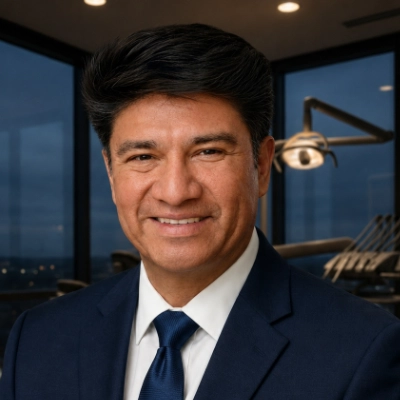
Leopoldo P. Correa
BDS, MS. D, ABDSM

Sovna S. Mishra
BDS, D, ABOP. D, ABDSM

Reimy Evangelista
DDS, MS, D, ABOP
GUEST FACULTY

Patricia Guerrero
DDS. D, ABOP

Juan Fernando Oyarzo
DDS, MSC, PhD

Hugo Campos
DMD, DDS, MS

Noah Siegel
MD. D, ABSM
The speaker lineup is subject to change.
TUITION AND PAYMENT SCHEDULE
Early registration tuition:
USD $10,950
Full payment by December 15, 2026.
Save USD $2,000 compared with standard tuition.
Standard tuition:
USD $12,950
| Payment | Amount | Due date |
|---|---|---|
| First installment | USD 3,200 | Upon registration |
| Second installment | USD 3,250 | February 15, 2027 |
| Third installment | USD 3,250 | March 15, 2027 |
| Final installment | USD 3,250 | April 15, 2027 |
To enroll in the course and make your payment securely, click on the following link to access the UT San Antonio School of Dentistry official platform:

Continuing Dental Education

University of Texas – Health Science Center
at San Antonio Dental School
is an ADA CERP Recognized Provider.
AGD PACE
subject codes
200 – Orofacial Pain
180 – Myofascial Pain/Occlusion
710 – Sleep Medicine
730 – Oral Medicine, Oral Diagnosis, Oral Pathology
010 – Basic Sciences
Conflict of interest disclosure statement
The Orofacial Sleep Consortium Global (OSC Global) is committed to ensuring balance, independence, objectivity, and scientific rigor in this course. All faculty, course directors, authors, planners, and advisory committee members must submit signed disclosures of relevant financial relationships with commercial entities. This requirement includes financial relationships of family members.
Disclosures are reviewed before the course by OSC Global and its advisory committee to identify and address potential conflicts of interest. Relevant relationships involving the provider and individuals controlling educational content will be disclosed to participants in written course materials and at the beginning of the educational activity. Individuals reporting no relevant financial relationships will also be identified.
OSC Global retains responsibility for faculty selection, educational content, instructional materials, and scientific integrity. Any financial or in-kind commercial support must be unrestricted and will be acknowledged in course announcements, educational materials, and at the beginning of the activity. Commercial supporters may not control educational decisions.
Course content remain free from commercial bias and present a balanced discussion of therapeutic options, using generic terminology whenever possible. Advertising, sales, and product promotion must be kept separate from the educational activity. References to products, services, or companies are solely for educational purposes and do not imply endorsement.